Our cutting-edge solar-powered vehicle designed and built by students to compete in the Solar Car Challenge.
Perihelion is our fourth-generation solar car, representing thousands of hours of student engineering, innovation, and craftsmanship.
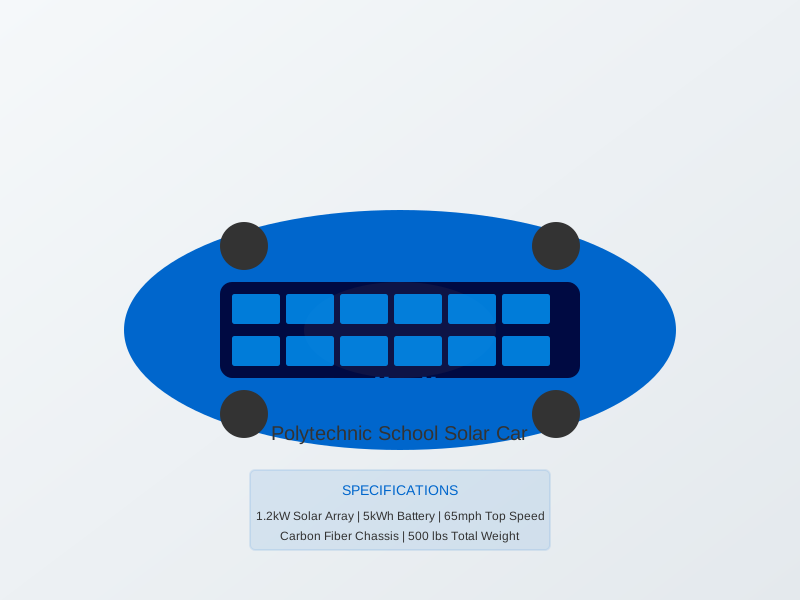
Named after the point in the orbit of a planet closest to the sun, Perihelion embodies our team's mission to harness solar energy for sustainable transportation. This single-occupant vehicle represents the culmination of our research, engineering, and continuous improvement from previous models.
Designed with a focus on aerodynamic efficiency, lightweight construction, and solar optimization, Perihelion demonstrates how student innovation can push the boundaries of what's possible in solar vehicle technology.
The engineering details behind Perihelion's performance and efficiency.
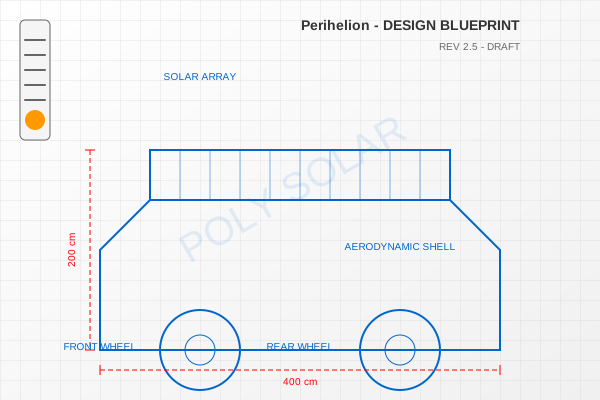
Perihelion features a 1.2 kW solar array consisting of high-efficiency monocrystalline silicon cells with an efficiency rating of 24%. The array is strategically positioned to maximize sun exposure throughout the day.
Our custom battery pack uses lithium-ion cells arranged in a configuration that optimizes power density, thermal management, and safety. The pack includes a sophisticated battery management system (BMS) developed by our team.
Perihelion uses a high-efficiency brushless DC motor with a custom controller that optimizes power usage based on driving conditions. The direct-drive system eliminates transmission losses for maximum efficiency.
Our chassis combines carbon fiber and aluminum components for an optimal balance of strength, weight, and safety. The aerodynamic shell is designed using computational fluid dynamics to minimize drag.
Perihelion features a comprehensive suite of sensors and telemetry systems that monitor all aspects of vehicle performance. This data is used for real-time strategy decisions during races.
Key innovations that set Perihelion apart in solar car design.
Using computational fluid dynamics and wind tunnel testing, we've achieved a drag coefficient of just 0.10, allowing Perihelion to slip through the air with minimal resistance.
Our proprietary BMS optimizes battery performance through cell-level monitoring and dynamic power allocation, extending range and battery life.
Perihelion features a unique system that can slightly adjust solar panel angles during stops to maximize energy collection based on sun position.
Advanced regenerative braking system recovers up to 80% of kinetic energy during deceleration, significantly extending the car's range.
Strategic use of carbon fiber, aramid composites, and aerospace-grade aluminum reduces weight while maintaining structural integrity.
Machine learning algorithms analyze race conditions, energy usage, and weather data to optimize driving strategy in real-time.
From concept to completion: how Perihelion was designed and built by our student team.
The process began with extensive research and conceptual designs. The team used CAD software to create detailed 3D models and simulations to test different design approaches.
We created custom molds and laid up carbon fiber to form the monocoque chassis. This labor-intensive process required precision and attention to detail to ensure structural integrity.
Our electrical team designed and built the power systems, including solar array mounting, battery pack assembly, motor controller, and wiring harnesses.
Custom software was developed for the battery management system, telemetry, driver interface, and race strategy algorithms to optimize performance.
Rigorous testing identified areas for improvement, leading to design iterations and performance enhancements. Road tests verified reliability and safety.
Final race preparations included driver training, chase vehicle setup, logistics planning, and creating maintenance protocols for the competition.
Images showcasing Perihelion from concept to competition.
Help us continue to innovate and compete at the highest level. Your support makes our solar car project possible.